The condition of customer support at present is a little paradoxical. Customers rave about wanting “great support,” yet they often (and systematically!) avoid speaking with support agents, flocking instead to customer self service options like FAQs and knowledge bases. What is the psychology of customer self service? Why customers prefer FAQs over agents boils down to this behavioral truth:
At 2 a.m., most users would rather interrogate a self service portal than endure even a three-minute wait over a phone call.
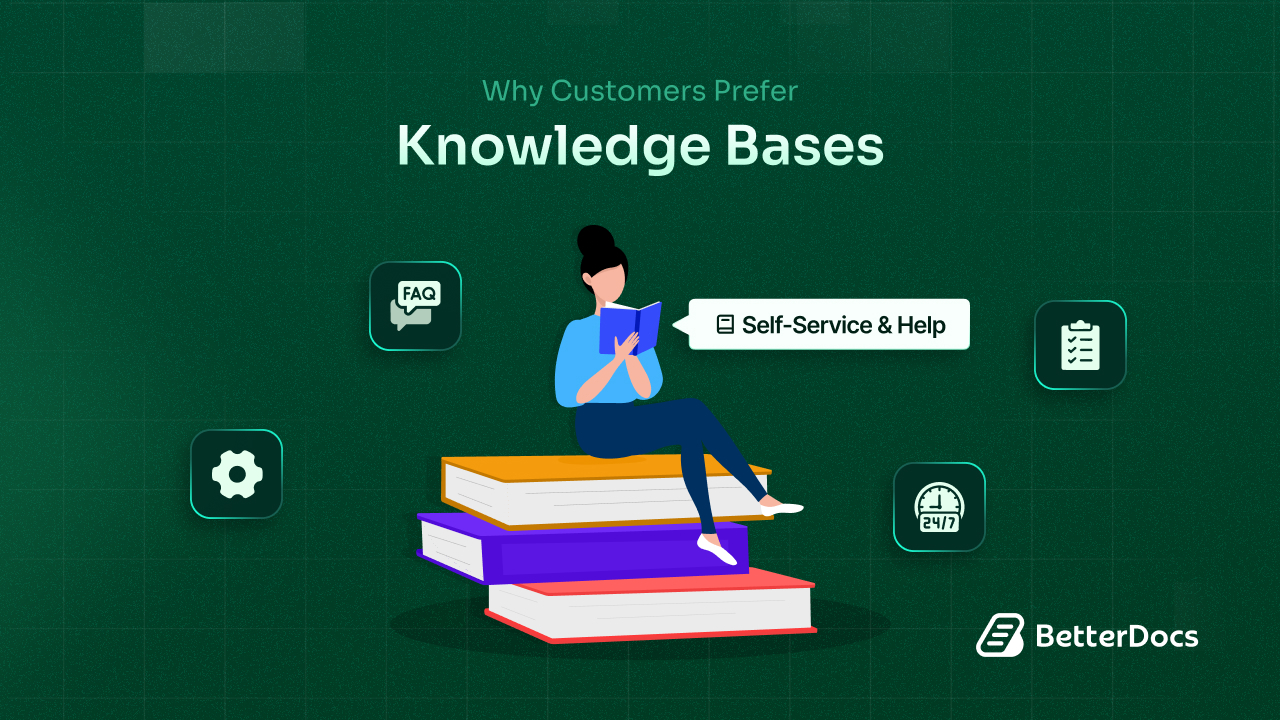
This phenomenon is more than just a tooling or AI trend. It is almost a self service customer service revolution rooted in psychological preference for autonomy and instant gratification. People crave the empowerment of solving issues independently, dodging the added mental work of live interactions, while simultaneously feeling rewarded for being able to self-solve.
This blog explores psychological explanations, social shifts and cultural lenses regarding the asymmetric preference for self service customer support. By the end, you will have a practical framework to design the best customer self service systems.
You will be able to map AI customer self-service psychology with platforms like BetterDocs. Keep reading to learn about actionable ways to incorporate hybrid self service into your business for higher deflection, satisfaction and loyalty.
The Evidence Is Strong, Customer Self-Service Is the New Default
Customer self service is no longer optional; it is the new default, backed by data that proves its dominance. Statistics show that customers attempt self-service first, turning to self-service customer support channels before even considering agents. Chatbots alone deflect 40–70% of tickets, handling routine queries with impeccable efficiency.
But (and there is one big BUT), only 14% of issues are resolved fully without escalation to humans. This does not mean failure, though. Simply that self service customer support filters complexity for when human support is non-negotiable, while providing help for the majority.
Customers prefer FAQs over agents, and self service is now the primary support channel in the customer’s mind. While deeper complexity may require human intervention, a customer’s first course of action when it comes to support is to look for solutions by themselves. At present, adopting customer self service as part of their core strategy is how businesses evade obsolescence.
(Although there is one interesting caveat. Keep reading to find out!)
Self Service Customer Support Is Great For…
Customer self service thrives in specific scenarios:
- Delivering unmatched speed where live agents falter.
- In repetitive, low-risk issues like password resets or order tracking, i.e., tasks users repeat across sessions.
- High-frequency queries, from “where’s my refund?” to basic troubleshooting
Time-sensitive moments amplify this edge: at 2 a.m. or mid-transaction, users crave interruption-free answers over hold music. AI customer self service tools like chatbots excel here, deflecting routine tickets with 24/7 availability.
Yet self service optimizes for speed and control, but not completeness. Complex escalations or emotional stakes demand human nuance. This realistic, as opposed to AI-optimistic, understanding positions customer self service as the frontline filter, not a universal fix. The advice here is this: businesses need hybrid models where AI customer self service hands off to agents, where needed.
Exploring the Psychology of Customer Self Service: Autonomy, Culture & Social Shifts
The preference for self service is not random, and is rooted in human psychology. Customers are not simply lazy or tech-obsessed. Rather, their behavior is driven by core psychological needs, social dynamics and cultural conditioning.
These forces explain why knowledge bases, FAQs and chatbot support often feel more accessible than speaking with a live agent. Below, we break down the main facets that shape the self service preference.
Sometimes, Autonomy Is Better
There is a theory in Psychology, Self-Determination Theory (SDT), whose application in regards to Consumer Psychology suggests that customers crave three innate drives:
- Autonomy (control over pace and path)
- Competence (mastery from solving it yourself)
- Efficiency (zero cognitive or social friction).
Knowing that, it is then pretty clear as to why customers prefer FAQs over agents. Customer self service delivers all three efficiently.
During an already busy day, browsing a knowledge base feels more productive than waiting on a support line with waterfall background music (which ironically feels more frustrating). Self service support hits the dopamine of personal victory. Customer self service preserves agency; agents, however skilled, impose someone else’s rhythm. AI customer self service amplifies this, offering 24/7 pathfinding without judgment or small talk.
Social Friction: Why Talking to Humans Can Feel Expensive
Talking to support agents carries an invisible psychological tax that customer self service eliminates entirely. Why do customers prefer FAQs over agents? Social anxiety and fear of judgment make live chats feel vulnerable.
💭 What if the agent thinks you are incompetent?
Introverts especially favor asynchronous self service customer support, solving issues solo without performative explanations. On top of that, there is cognitive load: repeating your story across transfers or escalations drains mental energy. Customer self service eliminates this as well. No small talk, no rapport-building, no awkward pauses.
This brings us to social shifts: People are increasingly self-focused, prioritizing individual efficiency over social obligation. COVID accelerated isolation-comfort; hybrid work normalized async communication and digital-first generations (Gen Z/Alpha) treat interactions as optional (often unwarranted) taxes. Remote lifestyles reduced tolerance for real-time latencies, amplifying self service customer service as the current default.
The Cultural Layer: Individualism vs. Relational Support
Customer self service adoption varies a lot by culture, though, showing that preference is not just about technology. In individualistic countries like the US and the Netherlands, people favor self service and AI tools, which reflects that independence is prized over interpersonal dependence. In other words, relying on oneself is prioritized over relying on someone else.
On the other hand, collectivist cultures like China and India lean toward voice channels, valuing relational trust and reassurance. For example, in India, even with the technology available, most support is handled by phone. This is due to cultural comfort with human interaction, uneven internet access and communication styles that favor live conversation over anonymous FAQs or chatbots.
The best customer self service adapts to context: preferences are shaped by culture and capability, not technology alone. In individualistic societies, self-service thrives; in relational, collectivist markets, success requires a hybrid approach that blends automation with human empathy. The most successful global strategies embrace both, avoiding a one-size-fits-all mindset.
Industry Reality Check: Where Self Service Wins & Where It Falls Short?
We have established that there is an asymmetric preference for customer self service across industries. It thrives where tasks are repetitive and low-stakes. In retail, self service customer support portals for order tracking and returns slash support tickets significantly. SaaS follows suit, with AI-driven documentation and searchable knowledge bases handling onboarding and API queries efficiently.
Yet some areas reveal clear limits. In banking and healthcare, apps can manage balances or appointments, but fraud disputes, diagnoses, or high-stakes decisions demand human intervention. Human intervention in these scenarios is non-negotiable from both business and customer perspectives.
Humans remain essential in these areas because high-stakes, complex and emotionally sensitive interactions demand judgment, empathy and trust that automation alone cannot provide. Self service customer service can handle routine tasks, but humans anchor credibility where it truly matters.
Using BetterDocs to Create Your Business’ Self Service Customer Support
What good is theory without application? As a company, your platforms need to execute customer self service and deliver autonomy, competence and hybrid flows for consumers. To do that, we create knowledge bases, a digital help desk with comprehensive customer self service.
However, a lot of knowledge bases can backfire, spiking tickets instead of deflecting them. That is because of poor navigation, chaotic structure and weak alignment with user intent, all of which leave users lost rather than empowered. When answers are hard to find, frustration replaces confidence. As a result, AI-powered customer self service without true ease of navigation does not reduce support demand; it negatively impacts trust instead.
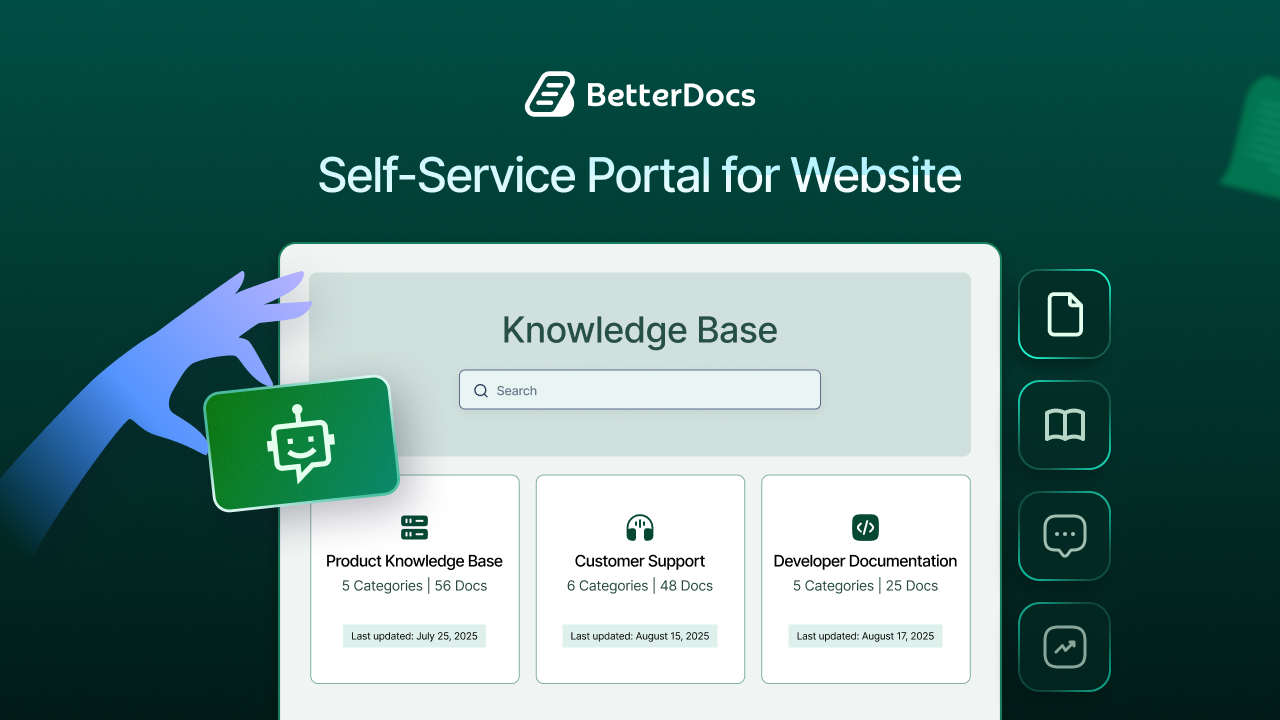
That is why we like BetterDocs. The WordPress documentation plugin prioritizes discoverability, confidence and instant resolution over sheer content volume. In doing so, it directly aligns with psychological principles supporting autonomy through user control and competence through problem-solving mastery.
Winning platforms minimize cognitive friction rather than burdening the user with endless pages. In this sense, BetterDocs functions not as a tool but as a customer self service infrastructure: a system designed around human psychology. With intuitive navigation that lowers mental load, it delivers faster answers, stronger self-resolution confidence and fewer unnecessary support tickets.
BetterDocs’ features are deliberately designed to even things out at the exact moments users hesitate, doubt, or disengage. When functionality aligns with how people think, search, and make decisions, customer self-service shifts from something mechanical to something intuitive.
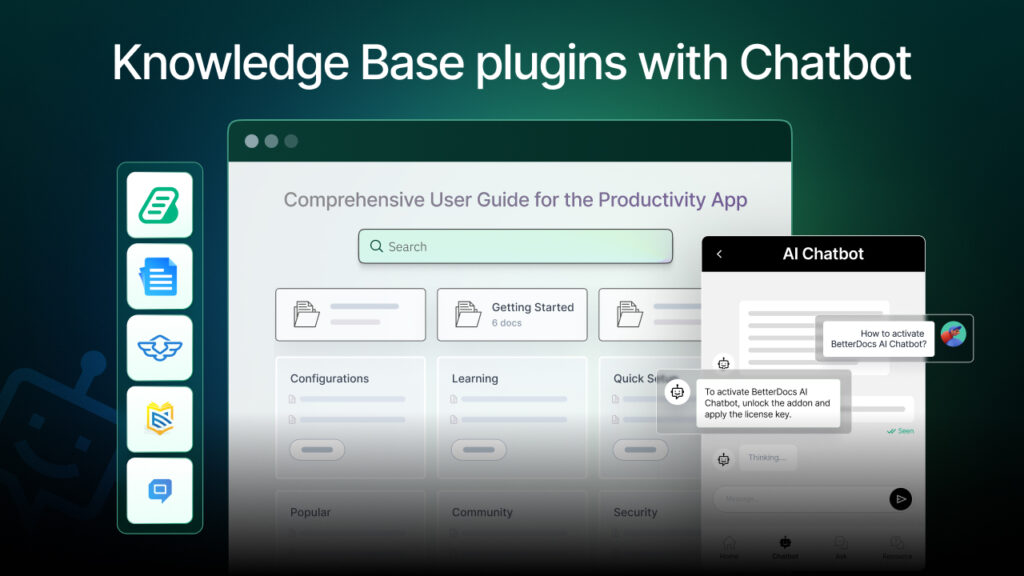
- Live search and the AI chatbot close the gap between question and answer. As soon as a user types, solutions appear instantly. This immediacy reduces effort, rewards users for trying, builds trust and reduces the need to contact a support agent.
- Clear Tables of Contents, thoughtful layouts and visible reading time guide users through content without confusion. By turning scanning into progress, this design boosts clarity and confidence. While they are finding answers, users also feel capable and a sense of achievement, being able to solve problems self-sufficiently.
- analitica and user Feedback close the loop between intent and outcome. With insights into every search and click. Combined with actual user reactions, you know exactly what works and what does not. Similar data can be collected via live-agent customer support as well, but it is not nearly as instant as documentation-assisted self-service.
- Multiple knowledge bases e role-based control keep information secure, relevant and easy to manage by showing people only what they need to see. This reduces risk, cuts noise, improves search accuracy and simplifies compliance in regulated environments.
Now Is Your Time to Build the Best Customer Self Service While Respecting Human Limits
The condition of customer self service, while a little paradoxical, is not about removing humans, but about restoring balance. Done well, it protects agents by freeing them from repetition and appreciates their role as one where judgment, empathy and trust truly matter.
It helps with expenses, sure, but customer self service also shows respect for users’ time, agency and mental energy. People do not resent support itself; they resent friction, delay and needless dependence. Self-service works when it grants autonomy first and offers humans as a strength, not a fallback. The future of support is not fewer humans, but fewer unnecessary conversations. Build that hybrid customer service and your customers will stay for it.
Further Reading:
If you found this blog helpful and are curious more for more, you might find the following blogs helpful in facilitating customer self service for your users.
📜 How to Create User Manual Guides Effectively in WordPress?
📜 How To Create Separate Documentation Site With WordPress
Also, you can subscribe to our blogs for more articles like this. Join our Facebook community as well to get the updates. Happy reading.