The biggest customer service trends for 2026 point to one clear shift: support is no longer just about fixing problems. It is becoming a growth driver, a retention tool and a major part of brand experience. Customers expect fast answers, seamless conversations across channels and service that feels personal without feeling invasive. Businesses that adapt early will be better positioned to reduce friction, build trust, and keep customers loyal.
At the same time, the latest customer support trends show that speed alone is not enough. The most important trends in customer service combine automation with empathy, efficiency with transparency and convenience with human judgment. In other words, the brands that win in 2026 will not be the ones that automate everything. They will be the ones who know when to automate, when to guide customers to self-help, and when to bring in a real human.
Quick Summary
Here is the short version of what matters most in 2026:
- AI will handle more routine interactions, but humans will remain essential for complex and emotional conversations.
- Customers will expect support teams to know their history, context, and preferences.
- Proactive service will matter more than reactive issue resolution.
- Omnichannel consistency will become a baseline expectation.
- Self-service will continue to grow, especially when powered by smart knowledge bases and AI search.
- Transparency, privacy, and ethical automation will directly affect customer trust.
Customer Service Trends Every Business Should Look for in 2026
A partire dal AI-powered support to self-managed documentation, different customer service trends will dominate how businesses actually function. Let us have a look at what customer service trends will look like in 2026.
AI-Powered Support
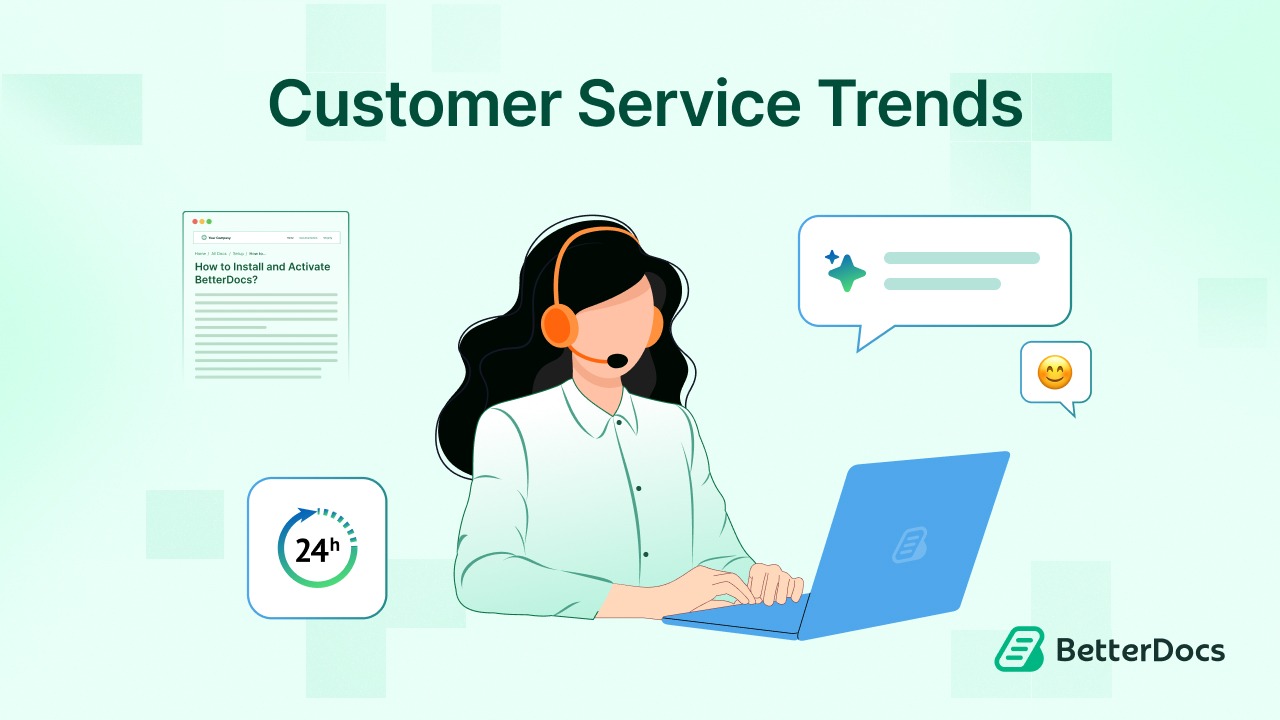
One of the clearest customer service trends for 2026 is the rise of AI as a first layer of support rather than a full replacement for support teams. Businesses are using AI to answer routine questions, summarize conversations, suggest next steps and route customers faster. Larger teams are going further with custom AI agent development services that work inside their own systems. But leading brands are pairing that automation with human agents who can step in when empathy, judgment, or flexibility is needed. That hybrid model is becoming the practical standard.
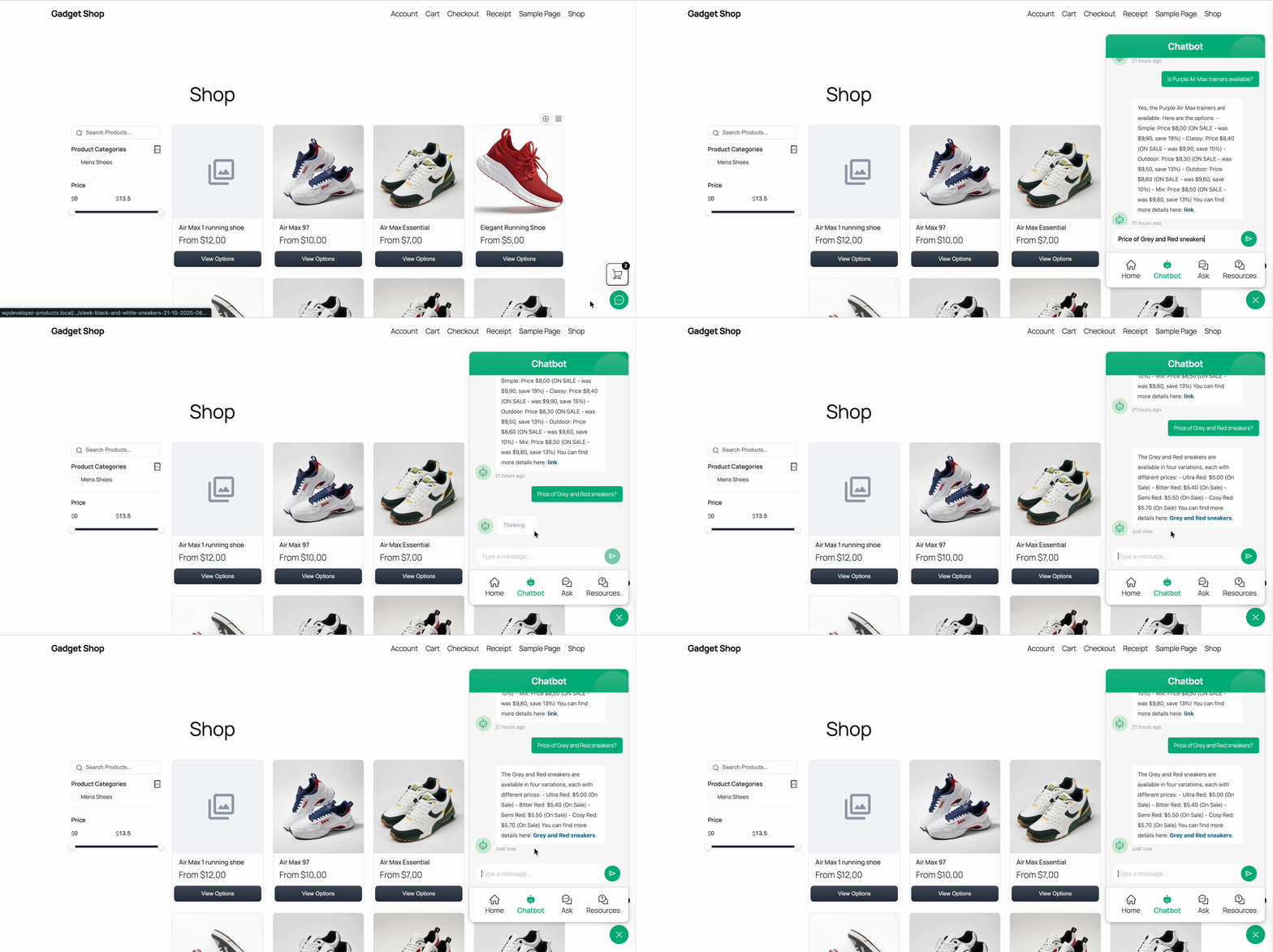
Providing such AI-powered support is possible for WordPress websites as well. If you are maintaining your sites in WordPress and want to improve customer support experience with AI, plugins like BetterDocs can help. It provides an AI Chatbot addon that allows you to train your chatbot and, based on your documentation, provides answers to customer queries. Businesses can provide 24/7 customer support with this chatbot and ensure a seamless experience for their customers.
Example: A SaaS company uses AI to instantly answer pricing, login, and billing questions, but sends cancellation requests or high-frustration chats to a live specialist who can retain the customer with a tailored solution.
Hyper-Personalization
Customers increasingly expect support that reflects their history, subscription level, previous issues, preferences and behavior. In 2026, support teams will rely more on connected customer data to personalize responses, surface relevant help articles and recommend the most effective next action. Personalization will not just improve service quality; it will reduce effort for customers.
Example: An eCommerce brand detects that a repeat buyer has experienced two delayed shipments in three months, so the next support interaction automatically includes priority handling and a loyalty credit.
Proactive Support System
Reactive support will not disappear, but proactive service will become one of the most valuable trends in customer service for businesses that want to reduce churn. Instead of waiting for customers to complain, brands will use alerts, usage signals and predictive analytics to identify issues before they escalate. This could mean warning customers about outages, reminding them about expiring subscriptions, or guiding them through a feature they appear to be struggling with.
Example: A hosting provider detects unusual downtime in one region and sends an in-app message with expected resolution time, a workaround, and status updates before customers even contact support.
Omnichannel Continuity
Being on email, chat, phone, and social media is no longer enough. In 2026, customers will expect those channels to feel connected. They should not have to repeat the same problem when moving from chatbot to human, or from email to live chat. Businesses that unify conversation history and customer context across channels will deliver smoother experiences and reduce frustration.
Example: A customer starts with a chatbot on mobile, uploads a screenshot and later continues by email. The live agent already sees the issue summary, attached image, and previous recommendations without asking the customer to start over.
Faster And Smarter Agent Copilots
Another major shift among customer support trends is the use of AI copilots inside support workflows. These tools help agents summarize past conversations, draft replies, detect urgency, recommend knowledge base articles and keep tone consistent. Instead of replacing agents, copilots reduce cognitive load and make it easier for teams to handle more volume without sacrificing quality.
Example: A support rep handling a technical issue gets an AI-generated summary of the customer’s last three tickets, the likely root cause and a suggested step-by-step reply that they can edit before sending.
Self-Service Support System
Among the strongest customer self-service trends for 2026 is the evolution of self-service from static FAQ pages to dynamic, searchable, context-aware help hubs. Customers want to solve simple problems on their own, but only if the experience is fast and useful. That means businesses need organized documentation, better search, clear article structure and AI-friendly knowledge content. This is also where tools like BetterDocs fit naturally.
A well-built BetterDocs knowledge base can help businesses create a more scalable self-service experience with categorized documentation, instant search, and support content that is easier to maintain and discover.
Example: A WordPress plugin company uses BetterDocs to build a searchable documentation portal with setup guides, troubleshooting steps and product updates, helping users solve common issues without opening a ticket.
Emotional Intelligence
As AI becomes more common, emotional intelligence will stand out even more. Customers do not always need a long conversation, but they do need to feel understood. In 2026, stronger service teams will design workflows that detect frustration, escalate sensitive cases earlier, and train agents to respond with empathy rather than scripts. Some AI systems will also be better at identifying tone and sentiment, but human judgment will remain critical in tense or emotionally charged moments.
Example: A travel company identifies distress signals in a customer’s message after a missed connection and routes the case to a senior agent empowered to rebook, refund, and reassure the traveler immediately.
Explainable AI And Data Transparency
As automation expands, customers will want to know how decisions are made and how their data is used. That is why explainable AI, privacy controls and transparent service policies are becoming core emerging trends in customer service. Businesses that clearly explain refund rules, moderation decisions, or account restrictions will reduce confusion and increase trust. The same is true for companies that are upfront about how customer data is collected and applied.
Example: Instead of saying “Your request was denied,” a platform explains that the refund request fell outside the policy window, links to the policy, and offers an escalation path for exceptions.
Community-Led Support
Support in 2026 will not live only inside official channels. More companies will invest in user communities, peer forums and customer-led knowledge sharing. These environments help customers learn from each other, surface real-world use cases, and reduce repetitive questions for support teams. Community support also strengthens loyalty because customers feel part of a larger ecosystem, not just a transaction.
Example: A developer tool brand creates a community forum where users share workflows, fixes, and integrations, while moderators convert high-value threads into official documentation.
Real-Time Insights
Support teams are moving away from delayed reporting and toward live operational insight. In 2026, businesses will use real-time feedback, sentiment trends, ticket clustering and conversation analytics to adjust staffing, update documentation, and fix recurring friction sooner. This shift turns support into an early warning system for product, onboarding, retention, and brand perception.
Example: A company notices a spike in chat volume tied to one new feature, updates the onboarding flow the same day, and publishes a help article before the issue becomes a larger support crisis.
How to Adopt the New Trends
After learning about the trends, it is a common question in mind, how to adopt these in the current business model. Here are some of the key tips on how these trends can be aligned:
- Audit your current support experience across chat, email, phone, help center and social channels to find where customers repeat themselves or drop off.
- Use AI for repetitive tasks first, such as tagging tickets, routing inquiries, drafting replies, and summarizing conversations.
- Keep a clear human escalation path for sensitive, high-value, or complex interactions.
- Build a strong knowledge base so self-service becomes useful, not frustrating.
- Organize documentation by customer intent, not just by internal product categories.
- Improve internal and external search, so answers are easier to find.
- Use BetterDocs as a documentation solution to centralize help content and make self-service scalable.
- Connect customer data sources carefully so agents can personalize support without switching between too many tools.
- Track signals like repeated contacts, churn-risk language and feature confusion to become more proactive.
- Create service policies that are transparent and easy to understand.
- Review privacy, consent and AI governance practices regularly.
- Train agents not only on tools, but also on empathy, ownership, and tone.
- Turn recurring questions into documentation, tutorials, or community posts.
- Measure customer effort, resolution quality, and repeat contact rate, not just response speed.
Which Trends Are You Going to Adopt Today?
As the top customer service trends for 2026 continue to evolve, one thing is clear: businesses can no longer treat support as a back-office function. Customers now expect fast, connected, personalized and trustworthy experiences at every touchpoint. From AI-assisted service and predictive support to omnichannel consistency and stronger self-service, the brands that adapt early will be better prepared to reduce friction, improve loyalty, and turn customer service into a competitive advantage.
Was this blog helpful? Do not forget to subscribe to our blog for more informative posts. Join our Facebook Community to discuss customer service and more.