Every time a user searches for answers in a help center, opens a product manual, or types a question into an AI assistant, they are interacting with documentation. It sounds mundane. But documentation is arguably one of the most high-stakes touchpoints in any product or service experience. Done well, it saves time, reduces frustration and builds trust. Done poorly, it drives users to competitors.
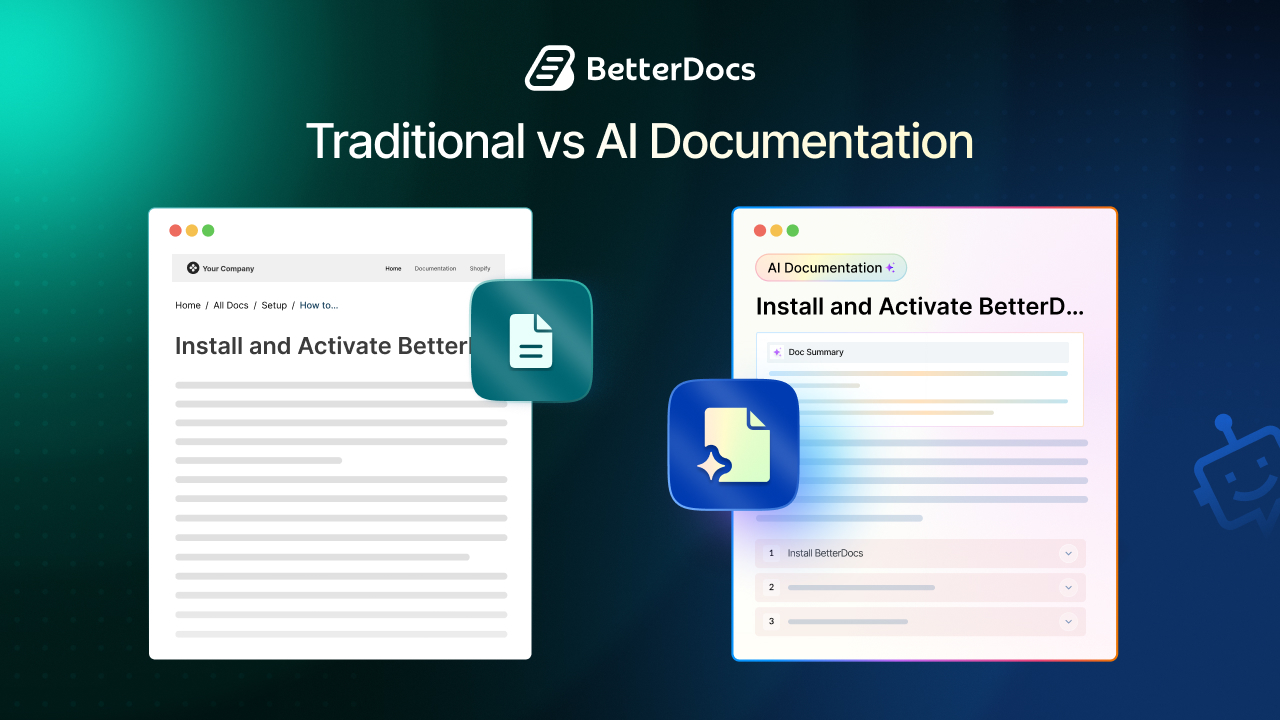
The rise of AI-powered documentation tools has fundamentally changed what users expect when they look for help. They no longer want to scan through 40-page PDFs or scroll through nested wiki pages, hoping to find one relevant paragraph. They want fast, accurate, conversational answers. At the same time, traditional documentation is not obsolete. Structured manuals, compliance docs, and step-by-step guides still serve critical purposes that AI cannot reliably replace.
So, AI vs Traditional Documentation, which approach actually works better for users today? The answer is nuanced. The right choice depends on your use case, your audience and the nature of the information itself. This blog breaks down both approaches, compares them across key dimensions, and helps you decide where each one fits in your documentation strategy.
TL;DR
Too long? Didn’t read? Here is a quick summary of the post.
| AI Documentation | Traditional Documentation | |
| Speed of access | Instant, conversational | Requires navigation and searching |
| Accuracy | Can hallucinate; needs oversight | Reliable when properly maintained |
| Personalization | High — adapts to user context | Low — one-size-fits-all content |
| Best for | FAQs, troubleshooting, and onboarding | Compliance, APIs, legal, technical specs |
| Maintenance cost | Lower with AI tools; needs curation | High — requires regular updates |
| Verdict | A hybrid approach works best for most organizations in 2026 | |
What Is AI-Powered Documentation And How Does It Work
AI-powered documentation refers to systems that use large language models (LLMs), natural language processing and retrieval-augmented generation (RAG) to help users find, understand and interact with information. Instead of presenting a fixed document for a user to read, these systems answer questions, summarize content, and guide users through processes in real time.
The most common implementations include AI chatbots embedded in help centers, AI search tools that surface relevant documentation snippets and AI writing assistants that auto-generate or update documentation drafts. When organizations use AI to generate documentation, an AI detector can also be useful for reviewing whether written content appears to have been generated by AI before it is published or added to a knowledge base. Tools like Notion AI, Guru, Confluence’s AI features and Intercom’s Fin are widely adopted examples as of 2026.
What makes them different from a standard keyword search is the ability to understand intent. A user who types “my payment keeps failing” is not looking for a document titled “Payment Errors.” They want to know why their specific payment failed and what to do next. AI systems can bridge that gap by interpreting the question and generating a contextually relevant response.
How RAG Works in Practice
Retrieval-Augmented Generation combines a search layer with a language model. When a user asks a question, the system first retrieves relevant documents from your knowledge base, then uses the LLM to synthesize those documents into a direct answer. This grounds the AI response in your actual content, significantly reducing hallucinations. It is the architecture that separates a well-built AI documentation tool from a generic chatbot that makes things up.
| 81% of users prefer self-service over contacting support (Salesforce, 2024) | 3x faster issue resolution with AI-assisted documentation tools (Gartner, 2025) | 67% reduction in repeat support tickets when docs are AI-searchable (Zendesk CX Trends, 2025) |
What Is Traditional Documentation And Why Does It Still Matter?
Traditional documentation encompasses any structured, human-authored content created to explain how something works. This includes user manuals, API references, product wikis, standard operating procedures, knowledge base articles, PDF guides, onboarding documents and technical specifications. These formats have been the backbone of enterprise and product documentation for decades.
The core strength of traditional documentation is authorial control. Every sentence is written, reviewed and approved by a human expert. There is no probability distribution involved. The information either says what it says or it does not. For regulated industries like healthcare, finance, and legal services, this deterministic quality is not a preference but a requirement.
Traditional docs also excel at structured navigation. When a developer needs to look up the exact parameters for an API endpoint, or when a compliance officer needs to cite page 47 of a safety manual in an audit, they need a permanent, citable document. AI-generated answers do not have page numbers. They cannot be cited in formal records. They may produce a different response between sessions.
Where Traditional Documentation Is Non-Negotiable
The FDA requires medical device manufacturers to maintain structured, version-controlled documentation. An AI chatbot that summarizes a device manual cannot substitute for the formal document itself in a regulatory submission. Traditional documentation is legally binding in many contexts. AI-generated content is not. This distinction matters enormously for industries where a documentation error can have serious legal or safety consequences.
AI Documentation vs Traditional Documentation: A Head-to-Head Comparison
Both approaches serve users differently across the dimensions that matter most: speed, accuracy, personalization, scalability and cost. Understanding how they compare on each front is the foundation of any sound documentation strategy.
| AI Documentation | Traditional Documentation |
| – Conversational, natural language interface – Personalized to user context and history – Scales to millions of queries with no added cost – Reduces time-to-answer dramatically – Can handle ambiguous or multi-part questions – Continuous learning from user interactions | – Authoritative, citable, version-controlled – Works without internet or AI infrastructure – Suitable for compliance and audit trails – Predictable and deterministic output – Accessible offline and in print formats – Trusted by technical and legal stakeholders |
Speed And User Experience
In terms of raw user experience, AI wins on speed. Studies found that users who accessed information through AI-powered search completed tasks faster than those using traditional help documentation. The reason is simple: traditional docs require users to already know what to search for. AI documentation meets users where they are, even when they use imprecise or conversational language.
Traditional documentation, however, often wins on trust. When users are making an important decision, like installing software, configuring a security system, or processing a refund, they frequently want to read the official structured guide rather than trust an AI summary that may or may not reflect the latest version of the truth.
Accuracy And the Hallucination Problem
Large language models can generate confident, fluent and completely incorrect answers. This phenomenon, known as hallucination, is a real risk when AI is deployed on top of a documentation system without adequate safeguards. A user who receives a wrong answer about how to configure their firewall, or how to dose a medication, can face serious consequences. This is the most critical weakness of AI documentation tools.
The industry response has been RAG architecture, stricter system prompts, and human-in-the-loop review workflows. These measures reduce errors significantly but do not eliminate them. Traditional documentation, when maintained correctly, simply does not have this problem. What is written is what a subject matter expert wrote and approved.
Maintenance And Scalability
Maintaining traditional documentation is labor-intensive. Every product update, policy change, or process revision requires a human to locate the affected documents, update them and ensure consistency across all related articles. In fast-moving organizations, documentation quickly becomes outdated, which erodes user trust and increases support volume.
AI documentation tools can reduce this burden in two meaningful ways. First, AI writing assistants can suggest updates based on product changelogs or code changes. Second, RAG-based systems pull from a source-of-truth database, so updating the database automatically reflects in AI responses. That said, this only works if the underlying data is kept current. AI amplifies the quality of your source content, for better or worse.
When AI Documentation Works Best for Users
Not all documentation use cases benefit equally from AI. The following scenarios represent the clearest opportunities where AI documentation delivers measurably better outcomes for users and support teams.
- Customer support and self-service help centers. AI-powered chatbots can resolve tier-1 support queries around the clock without human intervention. For SaaS companies with large user bases, this translates directly to lower support costs and faster resolution times.
- Employee onboarding and internal knowledge management. New employees can ask questions in natural language and get answers sourced from HR policies, process documents and internal wikis, without needing to know where any of those documents live or how the company’s folder structure is organized.
- Troubleshooting and diagnostics. Users dealing with errors, crashes, or configuration issues benefit enormously from conversational AI that can walk them through branching decision trees dynamically, rather than forcing them to follow a rigid printed flowchart that may not match their exact situation.
- High-volume, repetitive queries. If your support team answers the same 50 questions 500 times a week, AI documentation can handle all of them without fatigue, inconsistency, or increasing headcount.
- Multilingual user bases. AI tools can translate and respond in dozens of languages in real time, making documentation accessible to global users without the cost and delay of manual translation and localization.
When Traditional Documentation Remains the Right Choice
There are contexts in which traditional documentation is not just preferred but necessary. Relying solely on AI-generated answers in these scenarios creates significant risk.
- Regulated industries and compliance documentation. Healthcare, financial services, pharmaceuticals, and aviation require documentation that can be audited, version-controlled and legally cited. AI-generated content sometimes cannot fulfill these requirements, regardless of how accurate it appears. However, when done with human intervention, AI documentation can serve the purpose with accuracy as well.
- Developer and API documentation. Technical users like developers need precise, consistent reference material. A function signature, a response schema, or an authentication flow must be exactly right. Even minor AI-generated inaccuracies in technical documentation can break entire integrations and erode developer trust in the product.
- Safety-critical instructions. Step-by-step guides for hardware installation, chemical handling, electrical work, or medical procedures must be definitive. Users following safety instructions cannot tolerate probabilistic answers.
- Legal agreements, privacy policies and terms of service. These documents require careful human authorship and legal review. They exist as legal instruments and cannot be delegated to generative AI without significant legal and reputational risk.
- Offline and low-connectivity environments. Field technicians, rural healthcare workers and users in low-bandwidth regions need access to documentation that does not depend on internet connectivity or API availability.
The Hybrid Documentation Model: Best of Both Worlds
The framing of AI versus traditional documentation is somewhat misleading because the most effective organizations use both. The hybrid documentation model treats traditional, human-authored content as the authoritative source of truth and layers AI on top as the interface through which users access that content.
In practice, this looks like the following. A company maintains a well-structured knowledge base of articles, guides and technical specifications. An AI tool, powered by RAG, allows users to query that knowledge base in natural language. When the AI cannot answer confidently, it escalates to a human agent or links the user directly to the relevant article. This approach preserves accuracy because the AI is grounded in vetted human content, while delivering the speed and personalization that users now expect.
Stripe, widely regarded as having some of the best developer documentation in the industry, exemplifies this model. Their documentation site offers detailed traditional API reference pages alongside an AI assistant that answers natural language questions by drawing on those same reference pages. Developers who prefer reading structured docs can do so. Developers who want to ask questions can do that too. The two approaches serve the same users at different moments in their journey.
How to Match the Approach to the Scenario
| Scenario | Best Approach | Reason |
| Customer FAQ and support | AI | High volume, repetitive, speed-sensitive |
| API and developer reference | Traditional | Requires precision and citability |
| Employee onboarding | Hybrid | AI for Q&A, structured docs for policies |
| Compliance and audit documentation | Traditional | Legal and regulatory requirements |
| Product troubleshooting | AI | Dynamic, branching, context-dependent |
| Safety instructions | Traditional | Zero tolerance for inaccuracy |
| Multilingual user base | Hybrid | AI translation + human-verified source content |
Things to Keep in Mind When Opting for an AI-First Documentation Strategy
Before committing to an AI-first documentation strategy, product and knowledge teams should be aware of several well-documented challenges.
- First and most prominent is accuracy. Hallucinations in LLMs are not fully solved. Even with RAG in place, a model can confidently synthesize incorrect answers by mixing up details from multiple documents. Human review workflows and confidence scoring mechanisms are necessary safeguards, not optional additions.
- Second is data privacy. When users interact with AI documentation tools, their queries are often processed by third-party LLM providers. Organizations handling sensitive customer data, proprietary technical information, or personal health records need to evaluate carefully whether their AI documentation vendor’s data handling practices comply with GDPR, HIPAA, and other applicable regulations.
- Third is the risk of over-reliance. Teams that lean entirely on AI tools to maintain and generate documentation can lose institutional knowledge over time. If the AI cannot answer a question correctly because the source documents are out of date, users face a worse experience than if traditional docs had simply been kept current. AI amplifies what you feed it. Poor inputs produce poor outputs.
Tips to Choose the Right Documentation Strategy for Your Business
Start by auditing your current documentation. Identify your highest-traffic articles, your most common support queries, and your most frequently outdated content. These are your best candidates for AI augmentation. If 60% of your support tickets ask the same five questions, an AI assistant that answers those five questions reliably will deliver immediate and measurable ROI.
Next, identify your non-negotiables. Any documentation that is cited in legal or compliance contexts, that governs safety procedures, or that serves as a source of truth for technical integrations should remain in traditional structured formats. These documents should be the foundation of your RAG system, not replaced by it.
Finally, evaluate your infrastructure readiness. Deploying effective AI documentation requires investment in a clean, up-to-date knowledge base, a reliable RAG architecture, human review processes, and monitoring tools that flag low-confidence AI responses. Organizations that plug an LLM into a messy, outdated knowledge base and expect good results will be disappointed. The quality of your AI documentation is a direct reflection of the quality of your underlying content.
AI Or Traditional Documentation: Which One Should You Choose?
The debate between AI documentation and traditional documentation is ultimately a false binary. Both formats serve distinct and important purposes. Traditional documentation provides the accuracy, authority, and permanence that compliance, technical, and safety contexts demand. AI documentation provides the speed, personalization, and conversational access that modern users expect when they need answers quickly.
The organizations delivering the best documentation experiences in 2026 are not choosing one approach over the other. They are using traditional structured content as their source of truth and deploying AI as the intelligent interface that makes that content fast, findable, and genuinely user-friendly.
If your documentation strategy still treats these two approaches as competitors, it is time to rethink the relationship. Invest in your knowledge base. Keep your structured docs accurate and current. Layer AI on top with appropriate safeguards. That combination is what actually works best for users today.
If you are building documentation for a WordPress or Shopify product and want to explore how AI-powered knowledge bases like BetterDocs can fit into this hybrid model, it is worth seeing how purpose-built documentation tools handle this balance in practice. And if you found this blog helpful, subscribe to our blogs for the latest updates.