The way people search for information is changing fast. Instead of clicking through ten blue links, users now get direct answers from AI-powered search engines like ChatGPT, Perplexity and Google’s AI Overviews. This shift has given rise to a new discipline: Generative Engine Optimization (GEO). It is the practice of making your content discoverable and citable by AI systems.
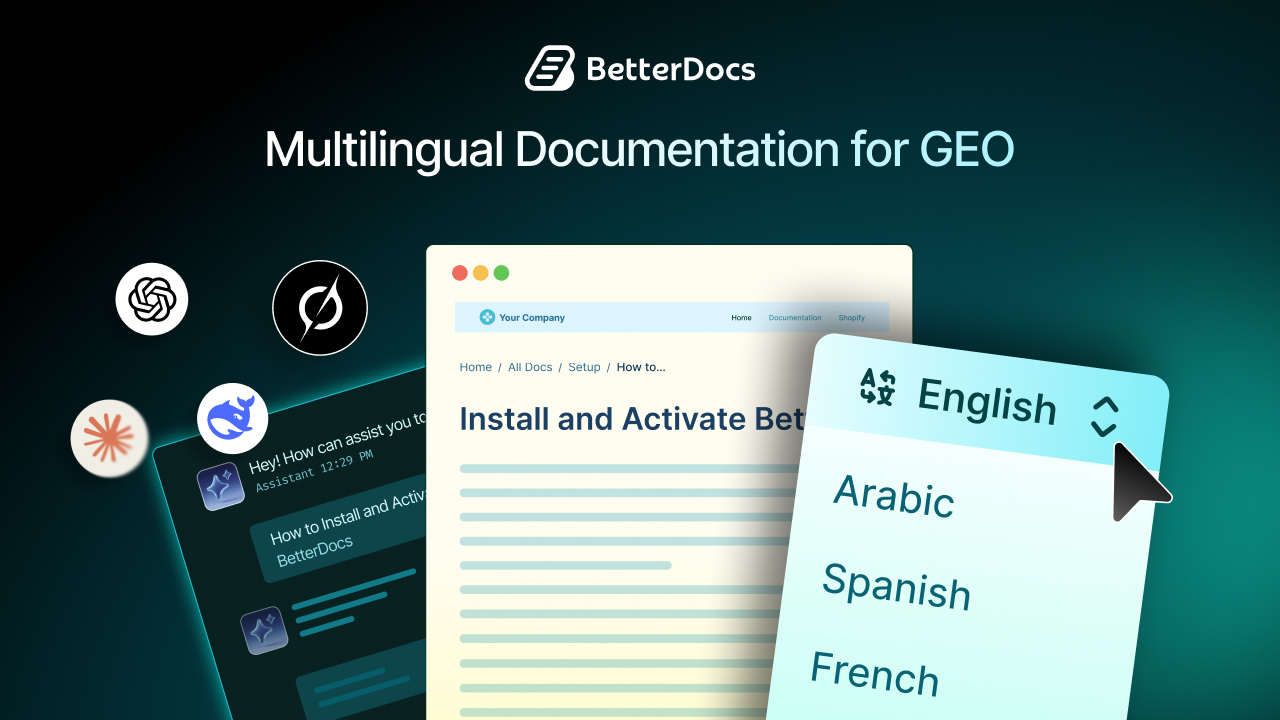
Now, imagine you have documentation in five different languages. The question is not just “will Google rank it?” The question becomes “will AI engines understand, trust and surface it for users across different languages and regions?” That is a much harder problem, and most documentation teams are not solving it yet.
This blog covers key strategies for optimizing multilingual documentation for GEO, from content architecture and schema markup to WordPress plugins like BetterDocs that simplify the translation workflow.
TL;DR (Too Long, Didn’t Read)
GEO (Generative Engine Optimization) is the practice of structuring content so AI search engines can find, understand and cite it. For multilingual documentation, GEO optimization requires more than translation. It demands proper structure, semantic clarity, regional relevance and technical signals that AI models can interpret regardless of the language. Here is a quick glimpse of what you will learn from the blog,
| What is GEO? | Generative Engine Optimization refers to structuring content so AI search engines can find, cite, and surface it in AI-generated answers. |
| Why it matters for docs | People ask AI assistants how to do things. If your docs are not GEO-ready, AI engines will not cite them, regardless of how good they are. |
| The multilingual challenge | Translation alone is not enough. Every language version needs proper structure, schema markup, hreflang tags and localized keyword intent. |
| Key strategies covered | Content architecture, semantic HTML, hreflang implementation, structured data, localized keyword research and content freshness. |
| Plugin spotlight | BetterDocs integrates with WPML to help teams create and manage translated documentation without breaking page structure. |
| Bottom line | Treat every language version of your docs with the same structural rigor as your primary language; that is how you win AI-driven search traffic across markets. |
What Is GEO And Why Does It Matter for Documentation?
Traditional SEO focuses on ranking in search engine results pages (SERPs). GEO focuses on getting your content cited or summarized inside AI-generated answers. These are two different goals, and they require different strategies.
Specifically, GEO matters for a clear reason for documentation: people ask AI assistants how to do things. When someone types “how do I set up two-factor authentication in [your product]?” into an AI search engine, you want your documentation to be the source the AI pulls from. If your docs are poorly structured or exist only in English, non-English speaking users will never see your content surfaced, even if it is technically excellent.
According to a 2024 study by Search Engine Land, AI-generated answers already appear in roughly 42% of all Google searches. That number is rising. Getting your multilingual documentation GEO-ready is no longer optional. It is a competitive advantage.
Understand How AI Engines Process Multilingual Documents
Before you optimize anything, you need to understand how AI engines read multilingual content. They do not simply translate your English page and consider the job done.
AI models are trained on massive multilingual datasets. They understand semantic relationships across languages. However, they still rely on structural signals to identify what a page is about, who it is for and whether it is trustworthy. A page written in French with no clear headings, no schema markup and no hreflang tags will confuse both traditional search engines and AI systems.
Here is what AI engines look for when processing multilingual content:
- Language clarity: Is the page consistently written in one language, or is it mixed?
- Semantic structure: Are headings, subheadings and paragraphs organized logically?
- Topical authority: Does the content cover a topic thoroughly, or is it shallow?
- Trust signals: Are there clear author attributions, publication dates and sources?
- Technical signals: Are hreflang tags, canonical URLs and structured data in place?
When your multilingual documentation satisfies all of these signals, AI engines are far more likely to treat it as a reliable source.
Build a Strong Multilingual Documents’ Architecture
Content architecture is the foundation of GEO success. Without it, even the best-written documentation will struggle to get surfaced by AI engines.
- Use a consistent URL structure across all languages: The two most common approaches are subdirectories (example.com/fr/docs/) and subdomains (fr.example.com/docs/). Subdirectories are generally preferred because they consolidate domain authority into a single root domain. AI engines recognize this structure and attribute topical relevance more reliably.
- Mirror your content structure across all language versions: If your English documentation has a section on “Getting Started,” your French, Spanish and German versions should have an equivalent section in the same logical position. AI engines build semantic maps of your site. Inconsistent structures create gaps in those maps.
- Avoid orphan pages: Every translated documentation page should be linked from a parent navigation page in the same language. Orphan pages, those with no internal links pointing to them, are often ignored entirely by both traditional crawlers and AI training pipelines.
Write Content That AI Can Actually Cite
Here is the practical core of GEO: AI engines do not just index content. They excerpt it. They pull the clearest, most direct answer to a question and present it to the user. Your multilingual documentation needs to be written with this in mind.
- Lead with the answer: Do not bury the key information three paragraphs deep. State the main point in the first one or two sentences, then expand on it. This “inverted pyramid” approach works extremely well for AI citation.
- Write in plain, direct language: This is especially important for non-English documentation. Complex sentence structures and idiomatic expressions are harder for AI systems to parse and harder for non-native speakers to read. Simple, clear sentences win every time.
- Use consistent terminology: If you call a feature “the dashboard” in one article, do not call it “the control panel” in another. AI engines build semantic graphs around terminology. Inconsistent terms fragment your topical authority.
- Keep paragraphs short and purposeful: Each paragraph should cover one idea. Three to five sentences is a good target. Long, dense paragraphs are harder for AI to excerpt cleanly.
These rules apply to every language version of your documentation. If your Spanish docs are written in dense, academic prose while your English docs are crisp and direct, your Spanish content will underperform in GEO regardless of translation quality.
Implement Hreflang Tags Correctly for AI Signals
Hreflang is an HTML attribute that tells search engines which language and region a particular page is intended for. It looks like this:
<link rel=”alternate” hreflang=”fr” href=”https://example.com/fr/docs/getting-started/” />
<link rel=”alternate” hreflang=”de” href=”https://example.com/de/docs/getting-started/” />
<link rel=”alternate” hreflang=”x-default” href=”https://example.com/docs/getting-started/” />
Hreflang tags are primarily a traditional SEO signal, but they matter for GEO too. AI systems that use web crawlers to train on or index live content use these tags to understand the relationship between language versions. Without them, AI engines may treat your French and English documentation pages as duplicate content and choose one to ignore.
Common hreflang mistakes to avoid:
- Forgetting the x-default tag (which signals your fallback page for unmatched languages)
- Setting hreflang to only one direction (every page must reference all its language variants, including itself)
- Using wrong language codes (use ISO 639-1 codes like fr, de, ja — not French or German)
Getting hreflang right is technical, but it pays dividends across both traditional SEO and AI-driven search.
Add Structured Data And Schema Markup to Every Language Version
Structured data is one of the most powerful GEO signals available. It tells AI engines not just what your page says, but what type of content it is, who wrote it and when it was last updated.
For documentation, the most relevant schema types are:
- TechArticle: Ideal for how-to guides and technical documentation
- FAQPage: Perfect for FAQ sections, which AI engines love to excerpt
- HowTo: Useful for step-by-step instructional content
- BreadcrumbList: Helps AI engines understand your documentation hierarchy
Every language version of your documentation should have its own schema markup, written in that language. A French documentation page should have French schema markup, not a copy of the English schema. This signals to AI engines that the page is a genuine, standalone resource for French-speaking users.
Here is a simple example of the TechArticle schema for a documentation page:
{

  "@context": "https://schema.org",

  "@type": "TechArticle",

  "headline": "Comment configurer l'authentification à deux facteurs",

  "dateModified": "2025-04-01",

  "inLanguage": "fr",

  "author": {

    "@type": "Organization",

    "name": "Your Company"

  }

}
The inLanguage property is particularly important for GEO. It explicitly declares the language of the content, reducing ambiguity for AI systems processing your pages.
Optimize Multilingual Documents for Keyword Intent Across Different Languages
A critical mistake in multilingual documentation is the simple word-for-word translation of the keyword strategy. A keyword that performs well in English may have a completely different search behavior in French, Japanese, or Portuguese.
👉 Conduct keyword research in each target language separately: Use tools like Google Keyword Planner, Ahrefs, or Semrush with the target country and language set correctly. Look at what questions real users in that region are asking. The intent behind a query can differ significantly by language and culture.
For example, English users might search “how to reset password.” French users might phrase it as “réinitialiser mot de passe” or frame it as a question: “comment réinitialiser mon mot de passe?” These are different phrasings and may have different search volumes and competition levels.
👉 Target question-based keywords in every language. AI engines are fundamentally question-answering machines. Documentation pages that are structured around specific user questions are far more likely to be cited. Build your headings around questions. Structure your content as direct answers.
👉 Localize examples and references, not just words. If your English documentation uses dollar amounts, US-based examples, or American idioms, your translated pages should adapt these for the target region. AI engines pick up on regional relevance. A French documentation page with French-appropriate examples will perform better for French-language queries.
Keep Your Documentation Fresh And Accurate
AI engines weigh content freshness and accuracy heavily. Stale, outdated documentation is a GEO liability. This challenge is compounded for multilingual docs because updates need to propagate across every language version.
Establish a documentation update workflow that covers all languages simultaneously. When you update your English docs, your translated versions should be flagged for update immediately. Letting translations fall behind creates a trust problem: AI engines may detect inconsistencies between language versions and downgrade the authority of all of them.
Display clear “last updated” dates on every documentation page. This is a simple but powerful trust signal. Both traditional search engines and AI systems treat visible publication and update dates as freshness indicators. According to Moz’s documentation on crawling and indexing, pages with clear timestamps are more reliably indexed and re-crawled.
Remove or consolidate outdated documentation rather than leaving it live. Dead pages are not neutral. They dilute your domain’s topical authority and can cause AI engines to surface incorrect information to users, which reflects badly on your brand.
Use Clear, Semantic HTML for All Documentation Pages
AI engines do not just read text. They parse HTML. The structure of your HTML tells AI systems what is important, what is a heading, what is a list, and what is body text.
- Use heading tags (H1, H2, H3) in a logical hierarchy: Never skip levels. Your H1 should be the primary topic of the page. H2 tags should be major subsections. H3 tags should be sub-points within those sections. This hierarchy is how AI engines build their internal understanding of your page’s content.
- Use semantic HTML elements appropriately. Use <article> for documentation content, <nav> for navigation, <aside> for supplementary notes, and <code> for code snippets. These semantic tags help AI engines understand content roles.
- Do not rely on visual formatting to convey structure. Bold text or large font sizes that are not backed by proper heading tags may look like headings to a human reader, but they mean nothing to an AI engine. Structure must be in the HTML, not just in the visual design.
This applies equally to all language versions. HTML structure is language-agnostic and must be equally strong across every translated page.
Simplify Creating Multilingual Documentation with BetterDocs
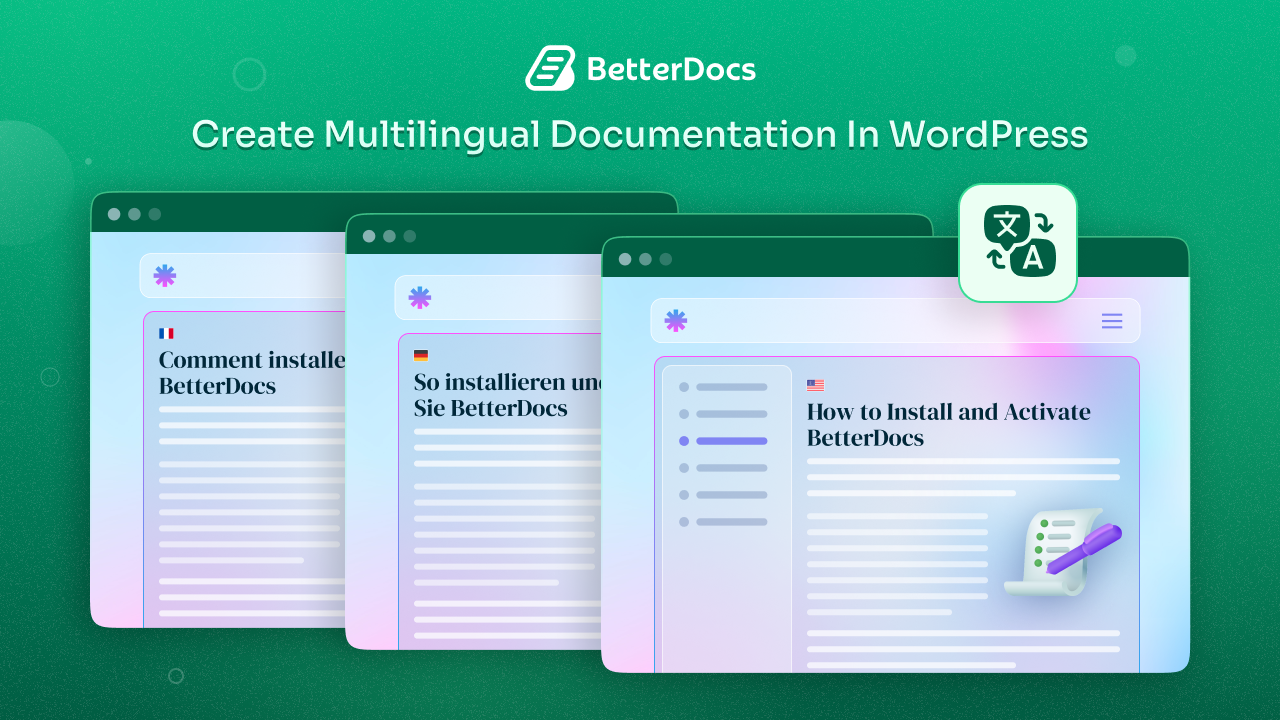
Creating and maintaining multilingual documentation is a significant operational challenge. Writing great content is one part of the work. Managing translations, keeping language versions in sync, and deploying them cleanly across a multilingual website is another challenge entirely.
BetterDocs offers complete compatibility with WPML (the most popular WordPress multilingual translation plugin), which makes it a practical plugin for teams managing documentation in multiple languages. It allows you to translate individual documentation articles into any language you need and use those translations seamlessly within a multi-language WordPress website. This means your documentation structure and your translated content can live together in one organized system.
What makes this particularly useful for GEO is that translation through BetterDocs and WPML preserves the original page structure, including headings, internal links and layout. This means every translated page inherits the same semantic HTML architecture as the original, which is exactly the kind of consistent structural signal that AI engines reward. You are not just producing a translated text file. You are producing a fully-formed, properly-structured documentation page that AI systems can read and interpret with confidence.
For documentation teams that want to scale multilingual content without rebuilding their workflow from scratch, BetterDocs provides a straightforward path. The translation process is built into the documentation workflow itself, rather than being an afterthought handled by a separate system.
Measure the GEO Performance of Your Multilingual Documents
You cannot improve what you do not measure. GEO measurement for multilingual documentation is still an evolving field, but there are concrete things you can track today.
- Track organic traffic by language and region. Use Google Analytics 4 with proper language and region dimensions to see how each language version of your documentation is performing. Look at organic search traffic specifically, not just overall traffic.
- Monitor AI Overview appearances. In Google Search Console, you can now see data on AI Overview appearances for your pages. Track which language versions of your documentation are appearing in AI-generated answers and which are not.
- Track keyword rankings by language. Use a rank tracking tool with multilingual support (Ahrefs and Semrush both handle this well). Track your target keywords in each language separately, in the appropriate regional Google search engine (google.fr, google.de, etc.).
- Review user behavior signals. Time on page, scroll depth and low bounce rates are signals that both traditional search engines and AI systems associate with quality content. If users in a particular language are bouncing quickly, that language version of your docs may need revision.
Multilingual Documentation Is a GEO Asset; Utilize It
Most documentation teams think about multilingual content as a translation project. GEO changes that framing entirely. Multilingual documentation, when done right, is a content asset that can capture AI-generated search traffic from multiple language markets simultaneously.
The teams that will win in an AI-driven search landscape are those that treat every language version of their documentation with the same structural rigor, semantic clarity and freshness discipline as their primary language. That means proper hreflang tags, structured schema markup, question-oriented content, localized keyword research and clean HTML architecture, applied consistently across every language you support.
Start with your most important documentation pages. Audit them in every language. Apply the principles in this guide. Then build processes to sustain that quality as your documentation grows. The investment is real, but so is the opportunity.
Have you explored BetterDocs documentation translation with the WPML integration? Let us know your thoughts. You can contact our dedicated support team for any further help, subscribe to our blogs for all the latest guides, and join our Facebook community to learn from all WordPress experts.