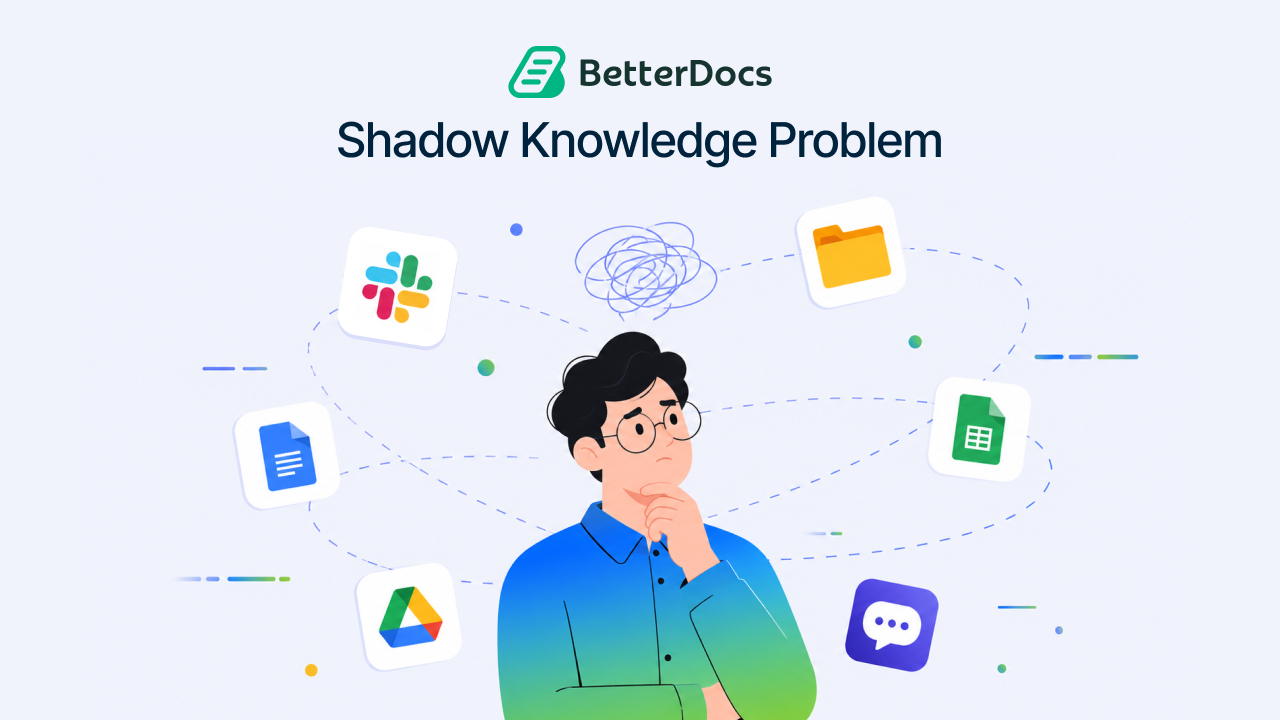
Shadow Knowledge is the undocumented, hard-to-find, or person-dependent information your team relies on every day to do its work. It lives in Slack threads, personal notes, browser bookmarks, old email chains, private Google Docs, and in the heads of veteran employees. The problem is not that this knowledge does not exist. The problem is that nobody knows where to find it when they need it. That creates delays, duplicate work, onboarding friction, and avoidable mistakes.
RingCentral reported that 56% of workers find searching for information across different applications disruptive, and more than two-thirds waste up to 60 minutes a day navigating between apps.
When documentation is fragmented, teams stop trusting the system and start relying on workarounds. Over time, that hidden layer becomes your real operating manual, even though it is invisible to everyone except a few insiders. A 2024 study of 716 employees found that 22.34% spend about an hour a day searching for information, while 10.47% spend two hours or more daily. That is exactly why auditing and centralizing team documentation is no longer optional for growing teams.
What Is Shadow Knowledge?
Shadow knowledge is the information your team uses but has not properly documented, organized, or shared in a central system. It usually develops outside formal documentation processes. Someone figures out the “real” way to handle a support escalation, a product handoff, or a client exception, but instead of updating the official docs, they share it in a message, mention it in a meeting, or keep it in a private note.
For example, your customer success team may have an unwritten refund workflow known only to two managers. Your developers may rely on setup fixes buried in a months-old Slack thread. Your marketing team may reuse campaign approval checklists stored in one person’s drive. In every case, the knowledge exists and creates value, but it is hidden, inconsistent and hard to scale.
Why Shadow Knowledge Exists?
Shadow knowledge does not appear because teams are careless. It usually appears because work moves faster than documentation and people optimize for speed in the moment instead of clarity in the long term.
- Teams share answers in chat because it is faster than updating a knowledge base.
- Subject-matter experts become the default source of truth, so knowledge stays person-dependent.
- Documentation ownership is unclear, which means nobody knows who should update what.
- Teams use too many disconnected tools, making information scattered across apps and folders.
- Older documentation becomes outdated, so employees stop trusting official resources.
- New processes get created informally during rapid growth, but never make it into documented workflows.
- Internal docs are often treated as a side task instead of an operational priority.
How to Avoid Shadow Knowledge Problems in Documentation?
To fix shadow knowledge, teams need more than a cleanup project. They need a repeatable documentation system that makes capture, review, discovery and maintenance part of daily work. The goal is not to document everything. The goal is to document the things your team repeatedly needs in a place everyone can trust.
Audit Sources
Start by identifying where your team’s operational knowledge currently lives. Review Slack channels, email threads, shared drives, meeting notes, project tools, SOP files, onboarding docs and internal wikis. Look for repeated questions, unofficial workarounds, and documents people reference often but cannot easily locate. This gives you a real map of your hidden documentation footprint.
Find Gaps
Next, compare what your team needs to know against what is formally documented. Focus on high-friction areas first: onboarding, handoffs, approvals, troubleshooting, escalation paths and recurring customer questions. If a process depends on asking a specific person, that is a documentation gap. If different people follow different versions of the same process, that is another one.
Set Owners
Every important document needs a clear owner. Without ownership, documentation becomes stale fast. Assign responsibility by function, not by accident. Product docs should have a product owner. Support workflows should have a support owner. Internal process guides should have a team lead or operations owner. Ownership creates accountability for updates, accuracy, and periodic review.
Standardize Structure
Hidden knowledge thrives in messy systems. Create templates for SOPs, policies, troubleshooting articles, onboarding guides and FAQs so teams can document information in a consistent way. A standard structure helps people write faster and helps readers find what they need without guessing where critical details might be buried.
Improve Discovery
Even strong documentation fails if nobody can find it. Centralize your content in one searchable knowledge hub, use clear categories, link related articles and track what people search for. Search behavior is especially useful because it tells you what your team expects to find but cannot. When the search fails, shadow knowledge grows back.
How BetterDocs Can Help to Avoid the Shadow Knowledge Problem
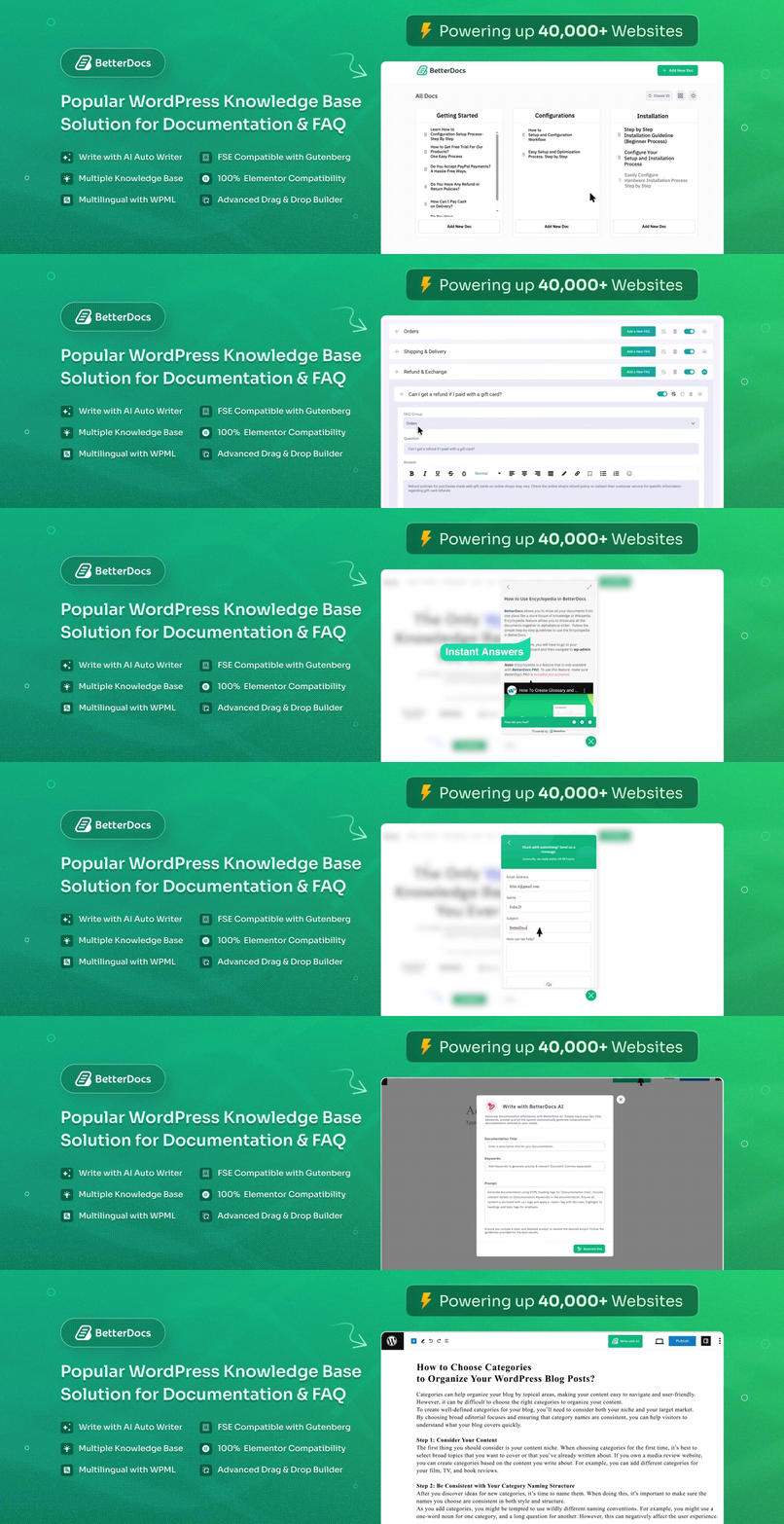
BetterDocs is an AI-powered documentation and knowledge base solution for WordPress. According to the company, it helps teams build and manage organized documentation with features such as internal knowledge bases, AI-powered search and analytics, and it is used by 40,000+ websites. For teams trying to centralize scattered knowledge, that combination matters because it supports both documentation creation and ongoing discoverability.
Internal Knowledge Base
One of the biggest reasons shadow knowledge persists is that internal documentation gets mixed up with customer-facing content or stays trapped in private files. BetterDocs supports an internal knowledge base with role-based access control, so teams can centralize internal-only documentation while controlling who can view specific docs, categories, or knowledge bases. That makes it easier to move “tribal knowledge” out of chats and into a secure, shared system.
Learn more: Should You Invest In An Internal Knowledge Base For Your Company?
AI Search
A central repository only works if people can actually use it. BetterDocs offers advanced live search and AI-powered search features that help users find relevant documentation faster. This directly reduces one of the main drivers of shadow knowledge: when employees cannot quickly find answers, they go back to asking people or searching old conversations instead. Better search encourages teams to trust documentation as the first stop, not the last resort.
Content Analytics
Shadow knowledge often hides in the gaps between what people search for and what your documentation actually answers. BetterDocs includes analytics for views, reactions, popular keywords, and “keywords with no result,” which can help teams identify missing articles, weak content and areas where the current documentation is not serving users well. In practice, that means you can audit documentation continuously instead of waiting for problems to surface through confusion or repeated questions.
How to Avoid the Shadow Knowledge Problem in Different Industries
The Shadow Knowledge problem mostly exists for the internal teams. Different industries can avoid these problems by simply implementing the Internal Knowledge Base system on their website. Here are some common ways different industries can avoid the Shadow Knowledge Problem on their website.
Healthcare Industry
Healthcare organizations deal with highly sensitive and fast-changing information every day. When medical protocols, patient handling procedures, or compliance guidelines are shared informally, teams can easily miss critical updates. An internal knowledge base helps healthcare teams centralize SOPs, onboarding materials, treatment workflows and compliance documentation in one secure place.
Manufacturing Industry
Manufacturing companies often struggle with operational knowledge being locked inside experienced employees or spread across departments. This creates delays during onboarding, equipment maintenance, and production troubleshooting. By creating an internal knowledge base, manufacturers can document machine handling processes, safety guidelines, production workflows, and training manuals to ensure operational continuity.
SaaS Companies
For SaaS businesses, shadow knowledge becomes a major issue when product updates, customer workflows, or technical processes are not properly documented. Teams often rely on Slack conversations or verbal explanations, which leads to inconsistent support and slower onboarding. A centralized internal documentation system helps SaaS companies maintain updated product knowledge, technical documentation, onboarding guides, and internal processes in one searchable hub. Discussions around SaaS documentation also highlight how teams rely on internal wikis and centralized repositories to avoid losing critical operational knowledge.
eCommerce Businesses
eCommerce businesses operate in fast-moving environments where product information, shipping policies, promotional campaigns, and customer support workflows constantly change. Without proper documentation, teams repeatedly ask the same questions, leading to inconsistent communication and operational inefficiencies. An internal knowledge base helps centralize product updates, return policies, onboarding resources and workflow documentation so every department works with the same information.
Start Turning Hidden Knowledge Into Shared Knowledge
Shadow knowledge is not just a documentation issue. It is a scalability issue. When important know-how is buried in private messages, individual memory, or disconnected tools, your team becomes slower, less consistent, and more dependent on a few people to keep things moving. The fix starts with a practical audit, clear ownership, and a centralized system that people can actually search and trust.
If you want to avoid shadow knowledge problems for the long term, treat documentation like infrastructure rather than admin work. Capture what your team repeats, organize it around real workflows, and use tools like BetterDocs to make internal knowledge easier to find, maintain, and improve over time. The sooner your team documents what it already knows, the sooner that hidden knowledge becomes a real operational advantage.
Was this blog helpful? If you would like to explore more blogs like this, subscribe to our blog. Is there anything you think is crucial for an effective policy and procedure manual? Do let us know in our Facebook community.